 |
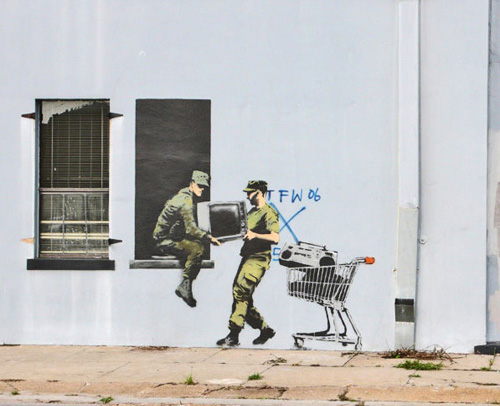
| This is a piece of street art that is by Banksy, a internationally renowned artist. It is not hard to see the "fine" art in this piece. The context and statement is very clever as well, for this is a piece done in New Orleans and is a mock reflection of what happened during hurricane Katrina. This artist is a very prolific street artist as well as a gallery artist. |
 |
| This is the street artist David Choe working on a piece. He is also very successful in galleries and is world renowned. Both Banksy and David Choe can be considered some of the best living artists today and definitely deserve a seat in art history. |
This misunderstanding of this new strand of modern art, and yes graffiti art is a progression in modern art, is due to the lack of seeing what this movement actually is by avoiding it at all costs or disregarding it as decay. The debate of street art as art has lasted so long because we haven't as a society completely analyzed the subject of the debate (Austin, 2010). Anytime, street art is discussed it is usually discussed in a negative manner as pure vandalism and destruction. Even with the rare times that it is described in a more positive light it is discussed and referred to as merely an urban subculture or a youth culture, a mere passing phase. However, fortunately it has been recently seen by scholars and recognizable institutions as what in fact graffiti art really is, which is an art form and an honorable addition to modern art and art history itself. To get to that conclusion, all that needs to be done is looking to this movement as an art form; discovering all its different styles, complexities, content, its artists, and how all of these different components tie into a whole. When graffiti art is analyzed completely it is easy to gain a new more appropriate perspective on this movement. Street and graffiti art, unlike the definition of “traditional graffiti”, is not destruction, it is creation (Austin, 2010). Conventional graffiti is defacement and focuses merely on substance, and can be attributed to pure destruction as a motive while graffiti art focuses on substance and aesthetics; more aesthetics than substance in most cases (Austin, 2010). When street art and graffiti art is studied one will find that this artistic expression has a lot of similar ties and parallels between fine art movements of the past; both in imagery and in message, as well as how the public react to the work (Austin, 2010). Just like modern art movements before graffiti was strongly opposed at first, being nothing of importance and rejected heavily, but recently it has gained rightful acceptance and recognition by some; and no longer is the ignorant opinion, that graffiti and street art are just random criminal acts with no importance other than destruction, the overtly dominant view.
Street and graffiti art have thrown modern art off balance. This movement has just taken art a step further and has made a stronger, more dangerous statement. This type of art disrupts the social visual order. The bland bleak cityscape is interrupted not by ads or company signs, but by an individual or collective artwork that is done purely for everyone to see, and which makes no profit for anyone so therefore is illicit. The authorities hold no control or say over these images that are randomly appearing through the city, which frighten them; for the people might see something other than what the ones in charge want them to see. Therefore their aesthetic order and control, which do play a big part in how people of the municipality interact, feel, and run things, is strongly interrupted by an image that is out of the normal visual realm and captures strong attention from anyone who spots it (Austin, 2010). When people see an individual's work up in an unauthorized place it shows people something that would have been otherwise unseen, masked by the “norms”. This act places power back to the people and shows what is really capable of us all.
Street and graffiti art is still struggling to gain recognition in this world; although the battle was a lot worse a few decades ago. Street art has proved by evidence that it is just like any other modern art movements of the past. This movement even possibly provides one of the strongest statements and most direct way to make that statement in all of art history. That is, the act of directly revolting against societal authority and “throwing a monkey wrench in the gears” of society by directly disrupting the visual norms, that were placed on us without our consent. This is obtained by graffiti's DIY attitude, taking over a space and putting up something that you want people to see without anyone's permission or approval. This act shows individual spirit and power, that is something to say while trying to create something beautiful or aesthetically intriguing, regardless of profit or controlling intentions. This act of defiance is positive, bold, and proves that we all still have a voice. Street and graffiti art is extremely important in our society and our history; even more so art history. For this is the biggest art movement since abstract expressionism and pop art, and takes art itself to a whole new level (Austin, 2010). Street and graffiti art is not just a random destructive act, it is a complex community filled with many diverse groups and cultures that are brought together by one common thing (Austin, 2010). This is not vandalism and could never be, for it is creation and destruction of any such creation is by definition vandalism.
Austin, J. (2010, February). More to see than a canvas in a white cube: For an art in the streets. City, 14(1/2), 33-47. Retrieved March 22, 2011. Retrieved from Academic Search Complete Database.
Banksy. (2008, August). http://www.hypebeast.com/image/2008/08/banksy-01.jpg.
David Choe. (2010). http://www.koreanbeacon.com/wp-content/uploads/2010/04/david-choe-3.jpg\.


No comments:
Post a Comment