Friday, May 6, 2011

Seeing The Art In The Mirror

Tag On Bear by artist Kid Zoom. Kid Zoom is an Australian artist who started out doing graffiti and street art. Recently he is gaining fame for his works and in 2010 had a big very successful gallery show in New York. This piece is actually from that show.  The hand portraits in the background are done with aerosol cans and show amazing skill. In the foreground is a stuffed bear that Kid Zoom tagged and put on a pedestal. This is a great example of how the art community is recognizing this art form as a legitimate part of art history and the fame that some of these artists are gaining.

Reflecting on this researched blog project assures me that I did indeed enjoy the journey. This project made me look at an issue, once I thought was relatively simple before I started, very much differently than what I expected to find. The issues on the views and feelings about street and graffiti art turned out to be much more complex, and in some cases very abstract. Each posting took me down a very different avenue to this universal issue; however each one remained relevant to the whole. Every article and posting brought me more insight into the images on the wall that I feel many people don't gain unless diving deep into a certain topic. Discovering all the different sides to this issue became not only an intellectual journey but an emotional one as well. This issue made me look at society and how everyday things are really controlled; intellectually it made me more aware. Emotionally, it sometimes angered me at what is valid and invalid; while also some parts made me happy to learn that as a whole we are not giving up, we can actually make a change if we really try.

This blog project, in my opinion, proved a more effective research trial than a conventional research paper. One reason is that it was an ongoing process that is never really finalized, so it does make you look further than what a regular limited paper would have you seek. The opinion base that is available and almost necessary in a blog also helped tremendously, for this is where all the information you read really has to be pondered on to make a statement. So this challenges the author of the blog more than what a paper would. All in all, the blog research project offered more opportunity to gain knowledge about a certain topic when compared to a traditional research paper. The last question I pose to my readers is: how do you now feel about urban art, and its place in this world?

Kid Zoom (2010). Tag on a bear. Retrieved May 6, 2011 from the World Wide Web: http://www.streetsandcanvas.com/wp-content/uploads/2011/03/KID-ZOOM-TAG-ON- BEAR.jpg.
 

Thursday, May 5, 2011

Inspired Art Or Commissioned Marketing?


Graffiti started out as a marketing campaign. It was a marketing campaign for the artist to show that they were there to claim their fame. As time progressed street and graffiti art became a little more elaborate. It became more creative, imaginative, and meaningful. Still at the beginning it was all just about getting your name out there; until it evolved and pieces started to pop up more image base driven than word or text driven. Then just like the reoccurring names gaining notoriety, the images were gaining a sort of power from their repeated use. Marketing is at the very essence of urban art and both ways, text or image base, are very effective ways to market oneself. However urban art uses this aspect of itself to pass on beauty and important messages.

Ever since I was very young, graffiti wasn't just an underground urban art form. It had been encompassed a little by the commercial world. I would see the imagery on many things that surrounded me at the time, such as skateboards, toys, clothes, music, and television. This imagery was prevalent everywhere I looked, whether this art influence was created by an actual graffiti artist or just a mock creation imitating the lettering or figures commonly used. Gradually the look and feel of this whole movement and the influence that it has over other things has changed and continues to do so to this day, as it is still very prevalent in the commercial mainstream. It moved from elaborate, colorful text driven imagery to the more simplistic, rustic stencil imagery that it is at today.

This style of art is now and has been used, for awhile now, by corporations and other big business in their advertisements. There has been a bit of a marriage between the two, big business and urban art, ever since the youth culture started to latch onto the street and graffiti art movement some time ago. To be honest, graffiti and street art are perfect for the advertising gig. So as urban art progresses and prevails, the businesses moved away from just using the mock imagery or artists for creations on billboards, signs, and TV commercials. They actually have started to pick up the tools of the artists themselves and bring it all back to its roots. Certain businesses are advertising by going out and creating street and graffiti art for their logos or supporting their products or company, aka “guerrilla advertising”. This is especially attractive for companies because guerrilla advertising attracts a new audience and is much cheaper than conventional advertising; and if these companies get caught with vandalism there isn't a big punishment for them, only a small fee that is much cheaper than paying for an advertisement (Delana, n.d.).

This new way to market is moderately attractive to street artists because they get paid to put up street art as long as it advertises the product in some way (Delana, n.d.). The real problem is that advertisements already litter the visual environment with a scourge of images trying to turn us all into drone consumers. Urban art was the only thing in the environment that was created individually with true integrity for the purpose of beauty and community message. Not to mention that urban art was usually always more intriguing to look at when compared to those bland advertisements. The lines between these two visual imagery avenues are blurring now that they are mixing; soon cities will be overrun by images that seem like street art, but in fact are just pounding brands into your head trying to sell you something. Urban art is the innocent amidst the already huge cluster of visual marketing that surrounds us everywhere we turn our eyes trying to force things upon us. Why ruin that one visual break that artists give from the consuming overload?


Delana. (n.d.). Guerrilla art versus guerrilla advertising: What’s the difference? Retrieved May 3, 2011, from http://weburbanist.com/2008/07/03/guerrilla-art-versus-guerrilla-advertising-whats-the-difference/.
Cross Walk Mr. Clean (2008). Retreived May 5, 2011 from the World Wide Web: http://www.adsavvy.org/wp-content/uploads/2008/09/guerilla-marketing-example1.jpg.


Wednesday, May 4, 2011

Visual Rhetoric


“Trash Men” by Mark Jenkins is a construction for street art. This is a illicit sculpture placed on the streets in London. It consists of four bags that are filled with some sort of material to make them seem like full trash bags. Then at the bottom of each bag are two openings where attached are realistic-looking but false legs that posed to look as if someone just through the bags down.


Street art isn't always just trapped on a vertical surface. Sometimes the art placed on the street comes in other forms, such as this installed sculpture. This particular artist specializes in this unconventional medium by placing installations and sculptures on the streets of some of the busiest cities in the world, letting the pieces seek people's notification.

“Trash Men” pulls at the pathos strings through shock and humor. Seeing this in a photograph or in person is quite shocking because at first you don't expect it to be what it really is, legs that are hanging out of the full trash bags. Although, it takes a little contemplation to come to the conclusion that the legs are just life size sculpted pieces with real clothes fitted on top that are arranged so that they are coming out of the bottom of the filled trash bags in a realistic pose.

At second viewing when more of your attention comes into play, you notice the legs and they seem very real, so an eerie feeling comes over you until you come to the realization that they are, in fact, fake. Then once the shock and spook factor wear off, the image becomes funny and ironic. The fact that someone would think of this scenario, of people actually being thrown out with and like the trash, in the first place and actually pull it off is humorously clever.

The image appeals to the logos (logic and information) part of you because it isn't logical at all. Being the opposite, it makes the logic program run to try and depict the message behind why people are in the trash. It is also logically shocking because these are normal everyday things (the trash bags, the pants, shoes and socks, and even the legs) that are usually close to one another in the same environment; however when you combine them it becomes very surreal and out of the ordinary; definitely something that you would never expect. The only way this image appeals to the ethos sense (integrity, trust) is the fact it makes you distrust the environment around you a little more and become more aware as well as suspicious. The connection of this construction to mythos (community) : this sculpture passes a message to the whole community, the message being to wake up and be more aware of your surroundings and also we need to work to prevent us all from becoming consumed by our trash; and anyone can interact with it for it is a tangible object that has no barriers around it.

Jenkins, M. (2010). Trash Men. Retrieved on May 2, 2011 from the World Wide Web at :http://sickoftheradio.com/2010/11/28/art-mark-jenkins-sculptures-speak/.


Friday, April 29, 2011

Images That Start Wars?

"I Want Change" by Banksy

     When faced with street art or graffiti, many people automatically recognize the consequences behind such an act and the huge risk that the artist took. When I hear about graffiti art from mainstream media and especially from authority groups, it all shines a negative light on this topic. They don't view it as a new art form, or a beautiful image or powerful statement, but as a criminal epidemic that is nothing less than immensely evil. Street and graffiti art to them is no harmless matter and is encouraged to be taken very seriously. So when the public views this type of art or possibly even choose to create some of their own, like myself they see along with artistic expression and freedom the chains of aesthetic norms and the chance of being criminalized. Personally, when I am thinking about an endeavor in this art movement, I realize that there is a much larger risk to act on it today than what there was maybe 10 years ago. This is mainly due to new technologies and tactics used by police officers in stomping this movement out; also the publics new founded awareness of this “vandalism” helps as most, even though gaining slight artistic recognition, are seeing street and graffiti art as pure negative destruction. All of this is very discouraging, and forces artists to have a more military-tactic oriented mind to evade prosecution.

      Ever since the “war on graffiti” was declared in the 1970s there has been an infiltration of military devices and strategies in civilian life and urban areas (Iveson, 2010). These special additions to every day life have continued through the decades and were at first meant to serve a harmless and helpful good. However, this approach to this so called war that has been adopted by the police force has created a marriage between the military and policing(Iveson, 2010). This marriage has grown through the years and now the lines are more blurred than ever between the police and the military. This progression has created more control and even hostility towards civilians; even in some cases has created an occupation-like-state in a few urban areas. Some of the new technologies and strategies that have been incorporated to rid the world of street and graffiti art, are new devices that greatly enhance security, detection, and prevention; new devices that remove graffiti with ease; new fortification of buildings; undercover and psychological operations, and propaganda (Iveson, 2010). Each of these new tactics have been used persistently to criminalize street and graffiti artists. These new detection and prevention ways that are used by the police, have surprisingly been very effective. However street and graffiti art still remains and is actually constantly growing.


Banksy- I want change. (n.d.) Retrieved on April 29, 2011 from http://lsffp.files.wordpress.com/2011/04/banksy-change.jpg
Iveson, K. (2010, Feb). The wars on graffiti and the new military urbanism. City,   14(1/2), 115-134. Retrieved March 22, 2011. Retrieved from Academic Search Complete.


Thursday, April 28, 2011

Visual Rhetoric


     Banksy piece in central London, that represents the lack of fear that the artist has of the CCTV and how wrong and pointless the CCTV actually is. The direct violation that the CCTV has on the right privacy and how it needs to be directly attacked, as well as discredited.

      This piece clearly appeals to our pathos mainly from a comedy factor. This piece is full of humor and mockery which will hopefully offer an outlet for a bit of laughter at the irony. Other than tickling the funny bone, this image should also cause a bit of anger to rise; for this points out how we are constantly being watched and tracked without our consent. The humor and wittiness of this stencil also appeals greatly to the logos factor, for this has a social/political statement about the way things are being ran and dealt with; stating in a clever way something that needs to be addressed. On the factor of Ethos, this image is completely full of integrity, for there is nothing that is hidden. In fact, it is actually making something that is supposed to be hidden and deceiving blatantly obvious. In regards to Myths, this directly effects the community by commenting on the society and making people of the community more aware of this issue that effects them all; while adding a bit of sarcastic patriotism in the mix.

Banksy (2008).Retrieved April 26, 2011, for the World Wide Web:       http://www.dailymail.co.uk/news/article-559547/Graffiti-artist-Banksy-pulls-  —despite- watched-CCTV.html.

Monday, April 11, 2011

Is “Real” Art Always In A Gallery?

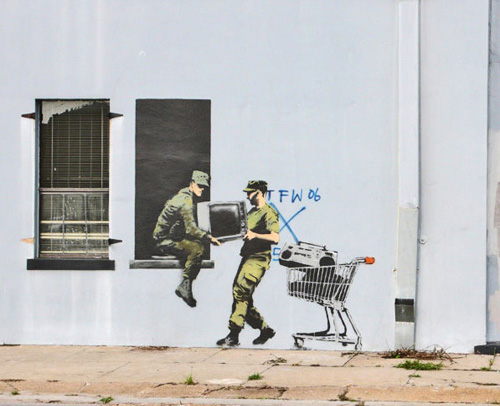
This is a piece of street art that is by Banksy, a internationally renowned artist. It is not hard to see the "fine" art in this piece. The context and statement is very clever as well, for this is a piece done in New Orleans and is a mock reflection of what happened during hurricane Katrina. This artist is a very prolific street artist as well as a gallery artist.
This is the street artist David Choe working on a piece. He is also very successful in galleries and is world renowned. Both Banksy and David Choe can be considered some of the best living artists today and definitely deserve a seat in art history.
  Most art classes I had during grade school, were very conventional and traditional. Paint a still life, draw a figure, even screen print. However anytime, I worked on or added any graffiti inspired imagery it was immediately discredited by my more conservative art teachers. So through the years, up until recently, my artistic growth was somewhat hindered by a conflict that developed  in my repertoire of imagery influences. This conflict was the question  is street and graffiti art in fact art; or is it just vandalism  as the institution scholars and majority of the art community claim it is.

    This misunderstanding of this new strand of modern art, and yes graffiti art is a progression in modern art, is due to the lack of seeing what this movement actually is by avoiding it at all costs or disregarding it as decay. The debate of street art as art has lasted so long because we haven't as a society completely analyzed the subject of the debate (Austin, 2010). Anytime, street art is discussed it is usually discussed in a negative manner as pure vandalism and destruction. Even with the rare times that it is described in a more positive light it is discussed and referred to as merely an urban subculture or a youth culture, a mere passing phase. However, fortunately it has been recently seen by scholars and recognizable institutions as what in fact graffiti art really is, which is an art form and  an honorable addition to modern art and art history itself. To get to that conclusion, all that needs to be done is looking to this movement as an art form; discovering all its different styles, complexities, content, its artists, and how all of these different components tie into a whole. When graffiti art is analyzed completely it is easy to gain a new more appropriate perspective on this movement. Street and graffiti art, unlike the definition of “traditional graffiti”, is not destruction, it is creation (Austin, 2010). Conventional graffiti is defacement and focuses merely on substance, and can be attributed to pure destruction as a motive while graffiti art focuses on substance and aesthetics; more aesthetics than substance in most cases (Austin, 2010). When street art and graffiti art is studied one will find that this artistic expression has a lot of similar ties and parallels between fine art movements of the past; both in imagery and in message, as well as how the public react to the work (Austin, 2010). Just like modern art movements before graffiti was strongly opposed at first, being nothing of importance and rejected heavily, but recently it has gained rightful acceptance and recognition by some; and no longer is the ignorant opinion, that graffiti and street art are just random criminal acts with no importance other than destruction, the overtly dominant view.

    Street and graffiti art have thrown modern art off balance. This movement has just taken art a step further and has made a stronger, more dangerous statement. This type of art disrupts the social visual order. The bland bleak cityscape is interrupted not by ads or company signs, but by an individual or collective artwork that is done purely for everyone to see, and which makes no profit for anyone so therefore is illicit. The authorities hold no control or say over these images that are randomly appearing through the city, which frighten them; for the people might see something other than what the ones in charge want them to see. Therefore their aesthetic  order  and control, which do play a big part in how people of the municipality interact, feel, and run things, is strongly interrupted by an image that is out of the normal visual realm and captures strong attention from anyone who spots it (Austin, 2010).  When people see an individual's work up in an unauthorized place it shows people something that would have been otherwise unseen, masked by the “norms”. This act places power back to the people and shows what is really capable of us all.

    Street and graffiti art is still struggling to gain recognition in this world; although the battle was a lot worse a few decades ago. Street art has proved by evidence that it is just like any other modern art movements of the past. This movement even possibly provides one of the strongest statements and most direct way to make that statement in all of art history. That is, the act of directly revolting against societal authority and “throwing a monkey wrench in the gears” of society by directly disrupting the visual norms, that were placed on us without our consent. This is obtained by graffiti's DIY attitude, taking over a space and putting up something that you want people to see without anyone's permission or approval. This act shows individual spirit and power, that is something to say while trying to create something beautiful or aesthetically intriguing, regardless of profit or controlling intentions. This act of defiance is positive, bold, and proves that we all still have a voice. Street and graffiti art is extremely important in our society and our history; even more so art history. For this is the biggest art movement since abstract expressionism and pop art, and takes art itself to a whole new level (Austin, 2010). Street and graffiti art is not just a random destructive act, it is a complex community filled with many diverse groups and cultures that are brought together by one common thing (Austin, 2010). This is not vandalism and could never be, for it is creation and destruction of any such creation is by definition vandalism.


Austin, J. (2010, February). More to see than a canvas in a white cube: For an art in     the streets. City, 14(1/2), 33-47. Retrieved March 22, 2011. Retrieved from Academic Search Complete Database.


Friday, April 1, 2011

Don't Listen When They Tell You Not To Take A Second Look

This is a good example of the different kinds of street art. This is a wall in Bremen, Germany, and the main piece that is focused on was done by the international artist Armsrock. His piece is the wheatepaste of the man walking. However, surrounding the man are tags and a few stencils, with at the far left some advertisements. As you can see there is beauty in this, and is pure art not vandalism. The wheatepaste is probably much nicer to look at and culturally richer than whatever the advertisement maybe beside it.

         
Everybody has a sentiment when it comes to street art. No one just looks at an image on the wall that was placed there illicitly to be seen by as many as possible, and just feels nothing. Its simply not possible. What those sentiments are of individuals vary greatly. A lot of times when someone sees the illegal image they suppress the natural feeling that arises inside of them with their preconceived emotions that they have gained from parents, institutions, jurisdiction, actually by mainstream society in general. These taught opinions then over take so all they see is a crime, degradation of society, and decay, ignoring the beauty right in front of them.
         
I had the same sentiment about street art once. All my life I was told only negative things about this artistic expression.  Teachers, movies, TV shows, programs at school, and especially my parents all waving a huge finger right in front of my face telling me that drawing on the wall is a crime and morally wrong.  Although, at the same time, I had a different influence about this culture from everywhere else. Reading and seeing graffiti in magazines and video games, my friends general like of the imagery and thrill of it all, and seeing the imagery on many different products that I consumed around that time, like clothes, CDs, and in the skateboarding culture. So you can imagine how conflicted I was anytime I saw it in person and trying to distinguish how I truly felt about it. Anytime I saw street art, I would immediately become enthralled and interested and want to stare, touch, and contemplate the piece. Then, voices would creep into my head telling me no, this is a crime, this is morally detrimental, this is someone's precious property! Then all of sudden I would become fearful to be associated with it.

Unfortunately,  those feelings that overtook the original ones are how most people view this type of art.  I feel most people go through the same battle with in themselves when confronted with street art, on whether to accept it or reject it. This just shows how much the authorities of municipalities have conditioned us to fit their criteria when dealing with this so-called “vandalism epidemic”. Shamefully most cities around the world see this artistic movement in the same light and deal with it as a harmful criminal activity that is to receive no tolerance what-so-ever. Some cities have tried to deal with street art in a progressive respectful manner, by negotiating compromise between its residents, artists, and authorities. However, this approach usually always turns to a total criminalization of illicit public art.  The city of Melbourne, Australia is a very goo example of this in there policies that were applied to street art and graffiti in 2005 to recently. At first they tried to create a balance in the community and a compromise where everyone would be content. This would be done mainly by zones: a no tolerance zone where no graffiti was allowed, then a limited tolerance zone where graffiti was permitted with consent by property owners, finally a tolerance zone which was a space for artists to do work without consent and hassle from authorities. However, this plan was suddenly rejected by the city council and a new “zero tolerance” plan was issued, with total criminalization of any illicit street art. Then with the recent high brow popularization of street art and graffiti and its new high priced market niche, the city council decided it would be appropriate to protect street artwork that was considered “important” and continue to eliminate all else.

This stance Melbourne took is very hypocritical. Street art shouldn't been seen as a moral dilemma or delinquent activity. It should be embraced for the art that it is and the beauty that it provides and the statements that it shouts. A compromise between citizens, artists, and authorities can do a city much more good than total eradication could accomplish. Instead of trying to erase; we need to see the pictures on the walls and hear what they have to say.

Laneway in Melbourne, Australia. It is absolutely covered in graffiti and street art. Layers upon layers of different styles, and art from locals but also international artists. These laneways were once a disgusting sight to the authorities of Melbourne. However, now they are internationally renowned and one of the city's most prize possessions.


Citation:
Armsrock. (n.d.).  Retrieved March 31, 2011, from http://unurth.com/42589/Armsrock-Bremen.
 
Burg, J. (2006). Beauty, INTERRUPTED. Parks & Recreation, 41(9), 104-107. Retrieved March 29, 2011, from the Academic Search Complete Database.
 
Laneway in Melbourne. (n.d.). Retrieved March 31, 2011, http://out-of-sync.com/collaboration/?p=51.

Young, A. (2010, February). Negotiated consent or zero tolerance? Responding to graffiti and street art in Melbourne. City, 14(1/2), 99-114. Retrieved March 22, 2011, from Academic Search Complete Database.
 

Friday, March 25, 2011

First Glance


Everyone in civilization, except an extremely rare few in this world, has seen street art or graffiti in some form. Be it spray paint on a wall, a wheat-paste around the corner, or even a etching into a stone surface or school desk. Since I was born, which was well after the popularization of street art, it has been an influence in my life ever since I was first able to comprehend visual images.

In my childhood the influence from this culture was everywhere, in almost every design. The toys were riddled with it, the shows, the ads, the clothes, the video games, and became especially prevalent in everything when I got into skateboarding. Eventually most of my drawings I did as a preteen were experiments with graffiti lettering and characters. This style of visual imagery has followed me throughout my life and continues to show up in certain ways through the art I produce today and has even led to my involvement in taking part of producing street art. Even the majority of the contemporary art I see now-a-days is tangled with street art imagery and impact from this movement. This genre has grown so large that very often I am learning about new artists or styles that are involved with this subculture.

However this art form hasn't always been this way, though it has been around longer than any other art form, and has had many ups and downs. Graffiti could be attributed back to the cave drawings in Lascaux, France, and then almost every civilization since then for recording events, writing slogans, and especially decoration. However, graffiti as we know it didn't show up until the late 1960s in Philadelphia and then moved to New York, where this new art form blew up. Originally it was done just by kids, usually in lower class neighborhoods, that just wanted to state their name and attain a kind of fame, and was closely tied to hip hop culture.

Then it moved to the West Coast, where it was largely used by gangs to mark territories and promote themselves, along with individual artists just doing it for the sake of it under high danger from authorities and gangs alike. This art expression grew and grew until it was very prominent in most major cities around the world and the public at first didn't know how to perceive or take it. Until in the 1980s when governments tried rigorously to stamp out graffiti and street art, seeing it as vandalism and attributing it to other more serious criminal activity and chaos. They slowed it down a bit and had many supporters and vigilantes on their side, however despite their efforts it still flourished all around the world, with many diverse groups embracing it.

Today, street artists are among some of the highest paid artists; important collectors are buying up works of art from graffiti artists for huge amounts of money, while many museums and galleries everywhere are showing it. Some of the street/graffiti artists hold an extremely prestigious status in the art world. Although, this movement isn't fully condoned yet by art history, authorities, or the general public; due to its ever evolving maturity and its strong social and political statements, it soon to be considered the greatest artistic movement since Pop art.
Drawings from the Lascaux cave in France. The images on this cave wall are speculated to be the first not only graffiti, but art that is known to humanity. The concept of graffiti (drawing on the walls) has been around since nomads conquered the world.

Graffiti as most people know it. This style of art since its start in the 1960's has continued development. This is a good image to show the maturity of the tag and the artistic ability and craziness, not to mention the amazing skill of can control, that was grew with time and helped this movement explode. This is as  much about recognition as it is about artistic expression, with the bold bright colors, and the huge size of this piece immediately gripping your attention and drawing you in.

This image is a good example of the current trend of moving away from tagging and writing ones name to almost a fine art approach. This is not done with an aerosol can, but is a wheat-paste. Even though the image is quite large, it has a nice subtleness to it that makes you take a second look and contemplate it's meaning.

Citation:
Lescaux cave mural. (n.d.). Retrieved March 23, 2011, from http://surferjerry.com/wp-content/uploads/2008/06/the-great-hall.jpg.

Nygard, J. (2008, January, 3). Gaffiti and street art: A brief history. Retrieved March 23, 2011, from http://www.associatedcontent.com/article/507055/graffiti_and_street_art_a_brief_history_pg3.html?cat=16


Swoon. (n.d.). Retrieved March 23, 2011, from http://30.media.tumblr.com/tFSlWhO5Xm21dvk42d50TPTxo1_500.jpg.