Friday, April 29, 2011

Images That Start Wars?

"I Want Change" by Banksy

     When faced with street art or graffiti, many people automatically recognize the consequences behind such an act and the huge risk that the artist took. When I hear about graffiti art from mainstream media and especially from authority groups, it all shines a negative light on this topic. They don't view it as a new art form, or a beautiful image or powerful statement, but as a criminal epidemic that is nothing less than immensely evil. Street and graffiti art to them is no harmless matter and is encouraged to be taken very seriously. So when the public views this type of art or possibly even choose to create some of their own, like myself they see along with artistic expression and freedom the chains of aesthetic norms and the chance of being criminalized. Personally, when I am thinking about an endeavor in this art movement, I realize that there is a much larger risk to act on it today than what there was maybe 10 years ago. This is mainly due to new technologies and tactics used by police officers in stomping this movement out; also the publics new founded awareness of this “vandalism” helps as most, even though gaining slight artistic recognition, are seeing street and graffiti art as pure negative destruction. All of this is very discouraging, and forces artists to have a more military-tactic oriented mind to evade prosecution.

      Ever since the “war on graffiti” was declared in the 1970s there has been an infiltration of military devices and strategies in civilian life and urban areas (Iveson, 2010). These special additions to every day life have continued through the decades and were at first meant to serve a harmless and helpful good. However, this approach to this so called war that has been adopted by the police force has created a marriage between the military and policing(Iveson, 2010). This marriage has grown through the years and now the lines are more blurred than ever between the police and the military. This progression has created more control and even hostility towards civilians; even in some cases has created an occupation-like-state in a few urban areas. Some of the new technologies and strategies that have been incorporated to rid the world of street and graffiti art, are new devices that greatly enhance security, detection, and prevention; new devices that remove graffiti with ease; new fortification of buildings; undercover and psychological operations, and propaganda (Iveson, 2010). Each of these new tactics have been used persistently to criminalize street and graffiti artists. These new detection and prevention ways that are used by the police, have surprisingly been very effective. However street and graffiti art still remains and is actually constantly growing.


Banksy- I want change. (n.d.) Retrieved on April 29, 2011 from http://lsffp.files.wordpress.com/2011/04/banksy-change.jpg
Iveson, K. (2010, Feb). The wars on graffiti and the new military urbanism. City,   14(1/2), 115-134. Retrieved March 22, 2011. Retrieved from Academic Search Complete.


Thursday, April 28, 2011

Visual Rhetoric


     Banksy piece in central London, that represents the lack of fear that the artist has of the CCTV and how wrong and pointless the CCTV actually is. The direct violation that the CCTV has on the right privacy and how it needs to be directly attacked, as well as discredited.

      This piece clearly appeals to our pathos mainly from a comedy factor. This piece is full of humor and mockery which will hopefully offer an outlet for a bit of laughter at the irony. Other than tickling the funny bone, this image should also cause a bit of anger to rise; for this points out how we are constantly being watched and tracked without our consent. The humor and wittiness of this stencil also appeals greatly to the logos factor, for this has a social/political statement about the way things are being ran and dealt with; stating in a clever way something that needs to be addressed. On the factor of Ethos, this image is completely full of integrity, for there is nothing that is hidden. In fact, it is actually making something that is supposed to be hidden and deceiving blatantly obvious. In regards to Myths, this directly effects the community by commenting on the society and making people of the community more aware of this issue that effects them all; while adding a bit of sarcastic patriotism in the mix.

Banksy (2008).Retrieved April 26, 2011, for the World Wide Web:       http://www.dailymail.co.uk/news/article-559547/Graffiti-artist-Banksy-pulls-  —despite- watched-CCTV.html.

Monday, April 11, 2011

Is “Real” Art Always In A Gallery?

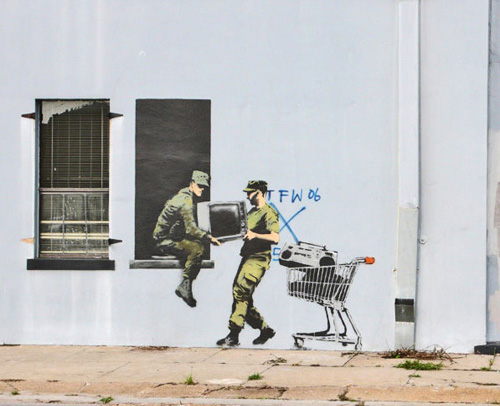
This is a piece of street art that is by Banksy, a internationally renowned artist. It is not hard to see the "fine" art in this piece. The context and statement is very clever as well, for this is a piece done in New Orleans and is a mock reflection of what happened during hurricane Katrina. This artist is a very prolific street artist as well as a gallery artist.
This is the street artist David Choe working on a piece. He is also very successful in galleries and is world renowned. Both Banksy and David Choe can be considered some of the best living artists today and definitely deserve a seat in art history.
  Most art classes I had during grade school, were very conventional and traditional. Paint a still life, draw a figure, even screen print. However anytime, I worked on or added any graffiti inspired imagery it was immediately discredited by my more conservative art teachers. So through the years, up until recently, my artistic growth was somewhat hindered by a conflict that developed  in my repertoire of imagery influences. This conflict was the question  is street and graffiti art in fact art; or is it just vandalism  as the institution scholars and majority of the art community claim it is.

    This misunderstanding of this new strand of modern art, and yes graffiti art is a progression in modern art, is due to the lack of seeing what this movement actually is by avoiding it at all costs or disregarding it as decay. The debate of street art as art has lasted so long because we haven't as a society completely analyzed the subject of the debate (Austin, 2010). Anytime, street art is discussed it is usually discussed in a negative manner as pure vandalism and destruction. Even with the rare times that it is described in a more positive light it is discussed and referred to as merely an urban subculture or a youth culture, a mere passing phase. However, fortunately it has been recently seen by scholars and recognizable institutions as what in fact graffiti art really is, which is an art form and  an honorable addition to modern art and art history itself. To get to that conclusion, all that needs to be done is looking to this movement as an art form; discovering all its different styles, complexities, content, its artists, and how all of these different components tie into a whole. When graffiti art is analyzed completely it is easy to gain a new more appropriate perspective on this movement. Street and graffiti art, unlike the definition of “traditional graffiti”, is not destruction, it is creation (Austin, 2010). Conventional graffiti is defacement and focuses merely on substance, and can be attributed to pure destruction as a motive while graffiti art focuses on substance and aesthetics; more aesthetics than substance in most cases (Austin, 2010). When street art and graffiti art is studied one will find that this artistic expression has a lot of similar ties and parallels between fine art movements of the past; both in imagery and in message, as well as how the public react to the work (Austin, 2010). Just like modern art movements before graffiti was strongly opposed at first, being nothing of importance and rejected heavily, but recently it has gained rightful acceptance and recognition by some; and no longer is the ignorant opinion, that graffiti and street art are just random criminal acts with no importance other than destruction, the overtly dominant view.

    Street and graffiti art have thrown modern art off balance. This movement has just taken art a step further and has made a stronger, more dangerous statement. This type of art disrupts the social visual order. The bland bleak cityscape is interrupted not by ads or company signs, but by an individual or collective artwork that is done purely for everyone to see, and which makes no profit for anyone so therefore is illicit. The authorities hold no control or say over these images that are randomly appearing through the city, which frighten them; for the people might see something other than what the ones in charge want them to see. Therefore their aesthetic  order  and control, which do play a big part in how people of the municipality interact, feel, and run things, is strongly interrupted by an image that is out of the normal visual realm and captures strong attention from anyone who spots it (Austin, 2010).  When people see an individual's work up in an unauthorized place it shows people something that would have been otherwise unseen, masked by the “norms”. This act places power back to the people and shows what is really capable of us all.

    Street and graffiti art is still struggling to gain recognition in this world; although the battle was a lot worse a few decades ago. Street art has proved by evidence that it is just like any other modern art movements of the past. This movement even possibly provides one of the strongest statements and most direct way to make that statement in all of art history. That is, the act of directly revolting against societal authority and “throwing a monkey wrench in the gears” of society by directly disrupting the visual norms, that were placed on us without our consent. This is obtained by graffiti's DIY attitude, taking over a space and putting up something that you want people to see without anyone's permission or approval. This act shows individual spirit and power, that is something to say while trying to create something beautiful or aesthetically intriguing, regardless of profit or controlling intentions. This act of defiance is positive, bold, and proves that we all still have a voice. Street and graffiti art is extremely important in our society and our history; even more so art history. For this is the biggest art movement since abstract expressionism and pop art, and takes art itself to a whole new level (Austin, 2010). Street and graffiti art is not just a random destructive act, it is a complex community filled with many diverse groups and cultures that are brought together by one common thing (Austin, 2010). This is not vandalism and could never be, for it is creation and destruction of any such creation is by definition vandalism.


Austin, J. (2010, February). More to see than a canvas in a white cube: For an art in     the streets. City, 14(1/2), 33-47. Retrieved March 22, 2011. Retrieved from Academic Search Complete Database.


Friday, April 1, 2011

Don't Listen When They Tell You Not To Take A Second Look

This is a good example of the different kinds of street art. This is a wall in Bremen, Germany, and the main piece that is focused on was done by the international artist Armsrock. His piece is the wheatepaste of the man walking. However, surrounding the man are tags and a few stencils, with at the far left some advertisements. As you can see there is beauty in this, and is pure art not vandalism. The wheatepaste is probably much nicer to look at and culturally richer than whatever the advertisement maybe beside it.

         
Everybody has a sentiment when it comes to street art. No one just looks at an image on the wall that was placed there illicitly to be seen by as many as possible, and just feels nothing. Its simply not possible. What those sentiments are of individuals vary greatly. A lot of times when someone sees the illegal image they suppress the natural feeling that arises inside of them with their preconceived emotions that they have gained from parents, institutions, jurisdiction, actually by mainstream society in general. These taught opinions then over take so all they see is a crime, degradation of society, and decay, ignoring the beauty right in front of them.
         
I had the same sentiment about street art once. All my life I was told only negative things about this artistic expression.  Teachers, movies, TV shows, programs at school, and especially my parents all waving a huge finger right in front of my face telling me that drawing on the wall is a crime and morally wrong.  Although, at the same time, I had a different influence about this culture from everywhere else. Reading and seeing graffiti in magazines and video games, my friends general like of the imagery and thrill of it all, and seeing the imagery on many different products that I consumed around that time, like clothes, CDs, and in the skateboarding culture. So you can imagine how conflicted I was anytime I saw it in person and trying to distinguish how I truly felt about it. Anytime I saw street art, I would immediately become enthralled and interested and want to stare, touch, and contemplate the piece. Then, voices would creep into my head telling me no, this is a crime, this is morally detrimental, this is someone's precious property! Then all of sudden I would become fearful to be associated with it.

Unfortunately,  those feelings that overtook the original ones are how most people view this type of art.  I feel most people go through the same battle with in themselves when confronted with street art, on whether to accept it or reject it. This just shows how much the authorities of municipalities have conditioned us to fit their criteria when dealing with this so-called “vandalism epidemic”. Shamefully most cities around the world see this artistic movement in the same light and deal with it as a harmful criminal activity that is to receive no tolerance what-so-ever. Some cities have tried to deal with street art in a progressive respectful manner, by negotiating compromise between its residents, artists, and authorities. However, this approach usually always turns to a total criminalization of illicit public art.  The city of Melbourne, Australia is a very goo example of this in there policies that were applied to street art and graffiti in 2005 to recently. At first they tried to create a balance in the community and a compromise where everyone would be content. This would be done mainly by zones: a no tolerance zone where no graffiti was allowed, then a limited tolerance zone where graffiti was permitted with consent by property owners, finally a tolerance zone which was a space for artists to do work without consent and hassle from authorities. However, this plan was suddenly rejected by the city council and a new “zero tolerance” plan was issued, with total criminalization of any illicit street art. Then with the recent high brow popularization of street art and graffiti and its new high priced market niche, the city council decided it would be appropriate to protect street artwork that was considered “important” and continue to eliminate all else.

This stance Melbourne took is very hypocritical. Street art shouldn't been seen as a moral dilemma or delinquent activity. It should be embraced for the art that it is and the beauty that it provides and the statements that it shouts. A compromise between citizens, artists, and authorities can do a city much more good than total eradication could accomplish. Instead of trying to erase; we need to see the pictures on the walls and hear what they have to say.

Laneway in Melbourne, Australia. It is absolutely covered in graffiti and street art. Layers upon layers of different styles, and art from locals but also international artists. These laneways were once a disgusting sight to the authorities of Melbourne. However, now they are internationally renowned and one of the city's most prize possessions.


Citation:
Armsrock. (n.d.).  Retrieved March 31, 2011, from http://unurth.com/42589/Armsrock-Bremen.
 
Burg, J. (2006). Beauty, INTERRUPTED. Parks & Recreation, 41(9), 104-107. Retrieved March 29, 2011, from the Academic Search Complete Database.
 
Laneway in Melbourne. (n.d.). Retrieved March 31, 2011, http://out-of-sync.com/collaboration/?p=51.

Young, A. (2010, February). Negotiated consent or zero tolerance? Responding to graffiti and street art in Melbourne. City, 14(1/2), 99-114. Retrieved March 22, 2011, from Academic Search Complete Database.